
Why Your Commercial Building Has No Hot Water — or Why It Won’t Stay Hot.
Hot water complaints are the fastest tenant call you’ll get. When a commercial building loses hot water — completely or intermittently — the cause is rarely the thermostat setting. In multi-tenant commercial buildings, hot water failure traces to equipment breakdown, sediment accumulation, failed mixing valves, recirculation system problems, or a system that was never sized for current demand. Here are six root causes, how to identify which one you’re dealing with, and what each fix actually involves.
WHAT YOU'RE EXPERIENCING
The Complaint Is “No Hot Water.” The Cause Depends on the Pattern.
Hot water problems in commercial buildings fall into three distinct patterns. Complete loss means no hot water at any fixture anywhere in the building — that’s an equipment failure. Inconsistent temperature means hot water is available but fluctuates unpredictably between hot and cold — that points to mixing valve, recirculation, or demand issues. Rapid depletion means hot water starts fine but runs cold quickly — which suggests capacity, sediment, or heating element problems. The pattern narrows the diagnosis before anyone opens a mechanical room door.
SYMPTOM PATTERN
Complete Loss of Hot Water
No hot water at any fixture in the building. Cold water runs fine. The water heater has stopped producing hot water entirely — failed burner, failed heating element, tripped gas valve, electrical fault, or control board failure. Check the pilot light (gas units) or breaker panel (electric units) before calling for service.
SYMPTOM PATTERN
Inconsistent Temperature
Hot water is available but temperature fluctuates — scalding hot one minute, lukewarm the next, or varying between fixtures. Points to a failed or miscalibrated mixing valve, a recirculation pump cycling erratically, cross-connections between hot and cold lines, or demand that exceeds the system’s recovery rate during peak periods.
SYMPTOM PATTERN
Hot Water Runs Out Quickly
Hot water starts at full temperature but goes cold after a few minutes of continuous use. The water heater is producing hot water but can’t maintain output under demand. Points to sediment buildup reducing tank capacity, a failing heating element (in electric units), a system undersized for current occupancy, or a dip tube failure that mixes cold inlet water with stored hot water.
DIAGNOSIS — SIX ROOT CAUSES
Six Causes of Hot Water Failure in Commercial Buildings.
Every hot water complaint we diagnose traces back to one of these six causes. All six are building-side problems a commercial plumber can diagnose and fix. The first — equipment failure — is the most common and usually the most straightforward. But the others can mimic equipment failure, which is why diagnosis matters before you approve a water heater replacement that may not solve the problem.
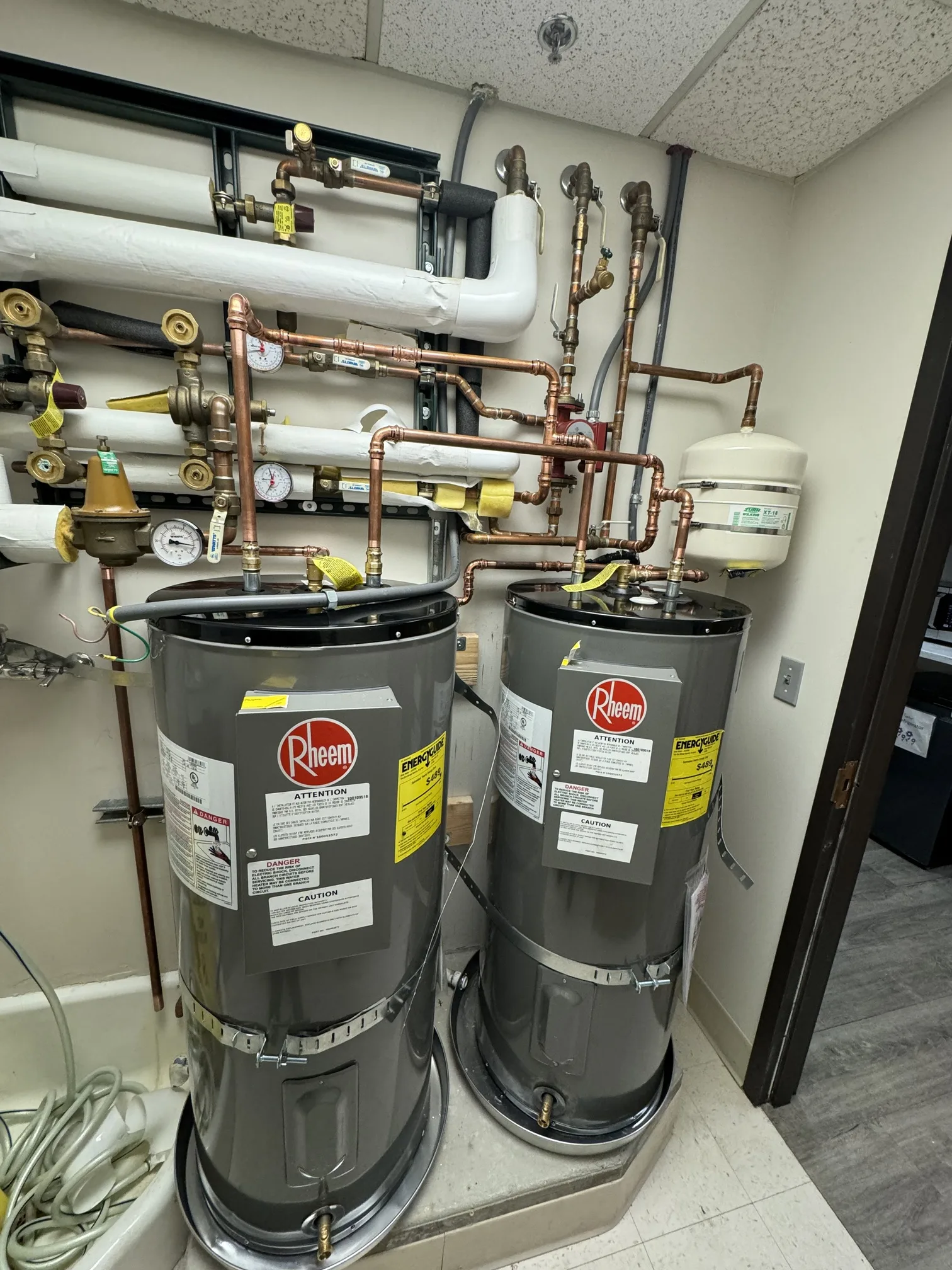
Water Heater Failure (Element, Burner, or Control Board)
Most Common CauseThe most straightforward cause: something inside the water heater has failed. In gas units, the burner assembly, pilot light, gas valve, or thermocouple may have failed. In electric units, one or both heating elements or the high-limit reset may have tripped or burned out. In both types, the control board or thermostat can fail. Commercial water heaters run harder than residential units — they fire more frequently, maintain higher temperatures, and serve higher demand. Expected lifespan for a commercial tank water heater is 8–12 years; tankless units last 15–20 years with proper maintenance.
Most likely if: Hot water stopped completely (not gradually). Unit is 8+ years old without regular maintenance. Pilot light is out (gas) or breaker has tripped (electric). No unusual noises or leaks prior to failure.
What the fix involves: Diagnosis of the failed component, repair or replacement of the element/burner/control board, or full water heater replacement if the unit has reached end of life. Water Heater Services →
Sediment & Scale Buildup in Tank
Check If Hot Water Volume Has Declined GraduallySouthern California has hard water. Over time, calcium and mineral deposits settle at the bottom of tank water heaters, forming a layer of sediment that insulates the water from the burner (in gas units) or buries the lower heating element (in electric units). The result is reduced heating efficiency, longer recovery times, and less usable hot water per cycle. In severe cases, the sediment hardens into a calcite shell several inches thick — effectively turning a 100-gallon tank into a 60-gallon tank. Popping or rumbling sounds from the water heater are the telltale sign — that’s water boiling under the sediment layer.
Most likely if: Hot water output has declined gradually over months, not suddenly. Water heater makes popping, crackling, or rumbling sounds during heating cycles. Unit has not been flushed or serviced in 2+ years. Water is slightly discolored at initial hot water draw.
What the fix involves: Tank flush and sediment removal (if buildup is moderate), or water heater replacement if sediment has calcified. Ongoing flush schedule through a maintenance program prevents recurrence. Maintenance Program →
Mixing Valve or Thermostatic Valve Failure
Check If Temperature FluctuatesCommercial buildings use thermostatic mixing valves (TMVs) to blend hot water from the heater (typically stored at 140°F to prevent Legionella) down to safe delivery temperatures (typically 120°F at fixtures). When a mixing valve fails, it can stick in the cold position (delivering lukewarm water despite a functioning heater), oscillate between hot and cold, or fail open (delivering dangerously hot water). Mixing valves are mechanical devices with wax elements or bimetallic springs that wear out — expected lifespan is 5–8 years in commercial applications. A failed mixing valve is often misdiagnosed as a water heater problem, leading to unnecessary heater replacement.
Most likely if: Water temperature fluctuates at the fixture but the water heater is producing consistent output. Temperature varies between fixtures served by the same heater. The mixing valve is 5+ years old and has never been serviced.
What the fix involves: Mixing valve inspection, recalibration, or replacement. Temperature verification at the heater output and at fixtures to confirm the valve is the issue. Water Heater Services →
Recirculation Pump Failure
Check If Hot Water Is Slow to ArriveMost multi-story commercial buildings have a hot water recirculation system — a pump that continuously circulates hot water through a return loop so tenants get hot water quickly at every fixture, without waiting for cold water in the line to flush out. When the recirculation pump fails, hot water sits in the pipes and cools. Fixtures far from the water heater deliver cold or lukewarm water until the standing water is flushed, which can take 2–5 minutes of running. If tenants complain that “hot water takes forever to arrive” or that “it’s only hot at certain fixtures,” a failed recirculation pump is the most likely cause.
Most likely if: Hot water takes 2–5 minutes to arrive at fixtures far from the water heater. Fixtures closest to the mechanical room have hot water, but distant fixtures don’t. The recirculation pump is not running or is making unusual noises.
What the fix involves: Recirculation pump inspection, impeller check, and replacement if failed. Verification of check valve and balancing valve function in the recirculation loop. Water Heater Services →
Expansion Tank Failure
Check If T&P Valve Is DischargingIn a closed-loop domestic hot water system (standard in most commercial buildings with backflow prevention devices), thermal expansion creates pressure spikes every time the water heater fires. The expansion tank absorbs that pressure. When the bladder inside the tank fails, there’s no buffer — pressure spikes trip the T&P (temperature and pressure) relief valve, which discharges water to relieve pressure. You’ll see water dripping or flowing from the T&P valve discharge pipe. A failed expansion tank doesn’t directly cause “no hot water,” but it causes the T&P valve to dump hot water, wastes energy, and accelerates water heater wear. Left unaddressed, it shortens the heater’s lifespan significantly.
Most likely if: T&P relief valve is periodically discharging water. Water puddles near the water heater with no visible leak in the plumbing. Pressure gauge shows spikes when the heater fires. Expansion tank feels uniformly heavy (waterlogged) when tapped.
What the fix involves: Expansion tank pressure check and replacement, T&P valve inspection, system pressure verification. Water Heater Services →
Undersized System for Current Demand
Check After Tenant Changes or BuildoutCommercial buildings evolve. A building originally designed for office tenants may now house a medical clinic, a gym with showers, or a restaurant — all of which draw dramatically more hot water than standard office use. When the hot water system was sized for the original tenant mix and the demand profile changes, the system simply can’t keep up. Hot water runs out during peak periods, recovery times are excessive, and tenants at the end of the distribution loop get lukewarm water. This is a capacity problem, not an equipment failure — the water heater is working correctly, it’s just undersized for current load.
Most likely if: Hot water problems started after a change in tenant mix or use type. Hot water is insufficient during peak periods (mornings, lunch) but adequate at off-peak times. Building has added high-demand tenants (food service, gym, medical) since the system was installed.
What the fix involves: Hot water demand assessment based on current fixture count and tenant use profiles, followed by system upsizing — additional tank capacity, a booster heater, or conversion to a high-recovery commercial unit. Water Heater Services →